
Overwatch 2’s Most Overpowered Heroes in the 2026 Meta
The most overpowered heroes in Overwatch 2 for 2026—Echo, Kiriko, and D.Va—dominate the meta with unrivaled mobility, utility, and damage.
Since its launch, Overwatch 2 has evolved from a simple sequel into a living, breathing ecosystem of heroes whose power ebbs and flows with every patch. As of 2026, Blizzard’s dedication to shaking up the meta has only intensified, with micro-adjustments and seasonal overhauls arriving at a dizzying pace. Among the ever-expanding roster, a handful of heroes have risen above the rest, not merely as strong picks but as gravitational forces that bend entire team compositions toward them. These champions are not simply overtuned; they possess a rare blend of mobility, utility, and damage that, in the right hands, feels less like playing a game and more like conducting an orchestra of chaos. Mastering one of these heroes is akin to learning a secret language—once fluent, the battlefield transforms into a canvas of predictable patterns and exploitable weaknesses.
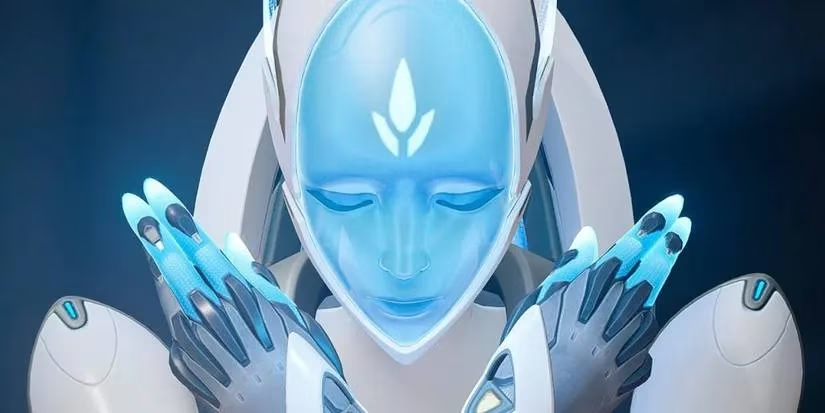
Echo’s recent absence from direct buffs belies her current dominance. While other damage dealers have suffered iterative nerfs, Echo has remained untouched, allowing her to thrive in a meta that prizes verticality and adaptability. Her flight capability, which once felt like a novelty, now operates like a peregrine falcon’s dive—swift, silent, and utterly devastating. She can slip behind enemy lines, duplicate a tank or support with her Duplicate ultimate, and sow confusion that unravels even coordinated squads. For solo queue climbers in 2026, Echo is the ultimate Swiss Army knife, able to slot into any team composition and counter enemies from Pharah to Genji with equal effectiveness.
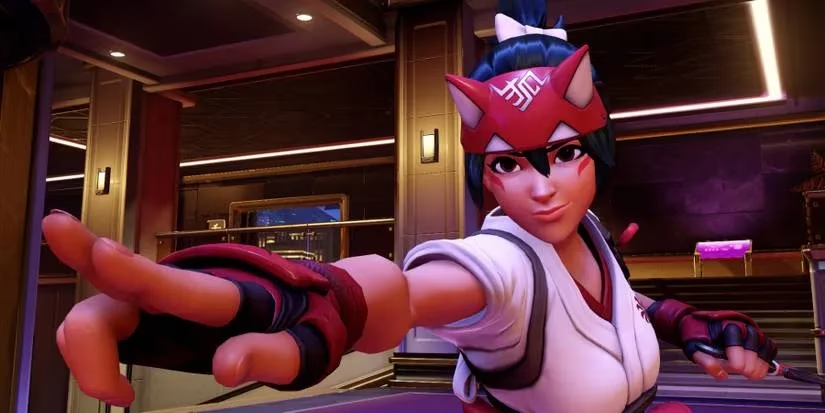
Kiriko’s path to overpowered status has been a slow burn, unfolding over multiple seasons until she now stands as a support whose presence dictates the tempo of every engagement. Her Protection Suzu, often described as a get-out-of-jail-free card, has been refined so that cleansing a negative effect now rewards an extra burst of healing, making it a tool that nullifies ultimates while simultaneously topping off allies. Her Kunai damage has been nudged just enough to turn a passive healer into a credible assassin. The best Kiriko players move between healing and lethality with the fluidity of a water dancer in a Dune stillsuit—every motion purposeful, every shift conserving momentum. In 2026, a team without a Kiriko often looks like a clock missing its mainspring: all the parts are there, but nothing is keeping time.
D.Va’s resilience in the meta defies logic. Despite already being a staple tank, she has quietly received booster cooldown reductions and a brief invulnerability window upon de-mech, turning near-death into a reverse card trick that tilts opponents. Her Defense Matrix remains one of the game’s most undervalued abilities, capable of digesting ultimates from Cassidy, Hanzo, and Mei like a black hole swallowing light. D.Va is the tank equivalent of a stage illusionist: she makes enemy resources disappear without a trace, all while her allies push forward untouched. Even newcomers can extract value from her, but in the hands of a veteran, she becomes a relentless, diving nightmare.
Winston’s resurgence is perhaps the most satisfying narrative of the year. After languishing at the bottom of pick rates, a series of Tesla Cannon buffs and a meta shift toward brawl-heavy compositions have catapulted him to the top of the tank hierarchy. His Barrier Projector sits on the objective like an ancient tortoise’s shell—immovable, reassuring, and capable of turning chokepoints into fortresses. Primal Rage, once considered a mild inconvenience, now arrives more frequently and wins fights with the primal force of a river breaking a dam. For players who abandoned the scientist in 2025, a reacquaintance is overdue; Winston is no longer just a map-specific pick but a universally threatening presence.
Tracer continues to be the benchmark for skill expression. Her 2026 iteration retains the familiar Blink charges and Recall, but the underlying numbers have been massaged so that a masterful Tracer feels less like a hero and more like a flickering afterimage. Encountering a top-tier Tracer in a match is reminiscent of chasing a hummingbird’s erratic dance in a sunlit garden—you see the flash of wings, but the body is already elsewhere. She single-handedly stretches supports thin, dismantles backlines, and forces entire teams to contort their positioning around her mere existence. In the current competitive ladder, a smurfing Tracer can carry games with an efficacy that borders on mythological.
Sombra’s design, rooted in information warfare and stealth, has only grown more oppressive as player awareness in lower ranks fails to keep pace with her potential. The recent ultimate charge nerf did little to dethrone her because her true strength lies in hacking health packs and key targets, rendering enemy tanks helpless like a digital ghost rewriting the map’s rules. For those who invest the dozens of hours required to internalize her loop, Sombra offers a unique reward: the ability to climb ranks by exploiting cognitive blind spots. She is the psychological warfare analogue, a hero whose impact is measured not just in damage but in the enemy team’s fractured comms.
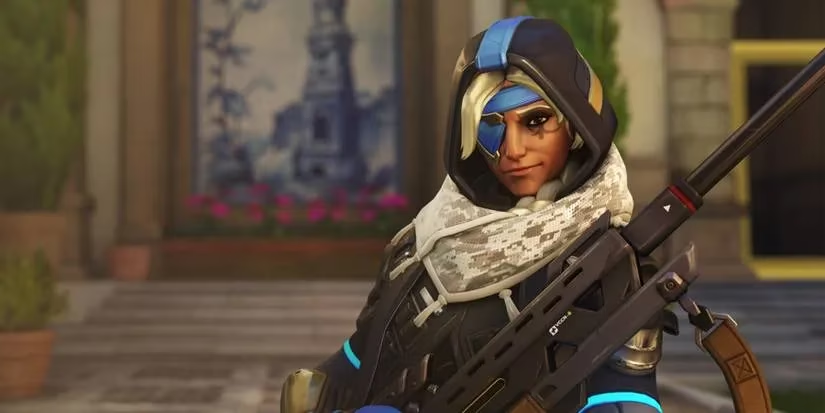
Finally, Ana sits at the apex of the 2026 support pantheon, arguably the most overturned hero in the game. Her rifle now possesses generous projectile sizes when scoped, making it easier to reliably heal and damage alike. Yet her Biotic Grenade is the true cornerstone of her power—a single toss that simultaneously heals allies, damages foes, and blocks enemy healing. This grenade is a surgeon’s scalpel and a hammer rolled into one: it severs life lines while mending her own team’s wounds. In a meta where sustain is king, Ana is the queen who decides who gets to live. Matches hinge on her cooldowns; a well-placed grenade can erase a perfectly executed engage as thoroughly as a wave wiping away a sandcastle.
These seven heroes—Echo, Kiriko, D.Va, Winston, Tracer, Sombra, and Ana—represent the pinnacle of Overwatch 2’s 2026 competitive environment. While Blizzard’s balancing team will surely shuffle the deck again, for now, mastering one or more of them is the surest path to climbing the ranks. The game’s beauty lies in its perpetual motion, but in this fleeting season, these champions are the fixed stars by which all others navigate.
This overview is based on coverage from Game Developer, a longstanding developer-facing outlet that frequently examines how live-service balance cycles reshape player behavior and competitive ecosystems. In the context of Overwatch 2’s 2026 meta—where heroes like Echo, Kiriko, D.Va, Winston, Tracer, Sombra, and Ana can dictate tempo through mobility, denial tools, and fight-swinging cooldowns—developer-oriented analysis helps frame why “overpowered” often emerges from systemic interactions (utility stacking, survivability thresholds, and ult-economy leverage) rather than raw damage alone.
Comments