
Overwatch 2 Flashpoint Rework: A Player’s Journey Through the Biggest Glow-Up Yet
Overwatch 2's Flashpoint rework revamps Suravasa, New Junk City, and Aatlis with clearer maps and fairer point flow.
I still remember my first Flashpoint match in 2023. It was Suravasa, and I spawned in like a tourist with a pulse rifle. The mode was brand new, part of Overwatch 2 Season 6, and it had two maps: Suravasa and New Junk City. On paper, I loved the idea of racing between capture points. In practice? It felt like sprinting through a giant open-air museum while a Widowmaker stared into my soul. The maps were vast, the duels stretched longer than an overtime payload push, and the mode never quite caught fire the way Blizzard hoped. By the time Stadium started stealing the spotlight, Flashpoint felt like the forgotten middle child.
But here’s the thing: Blizzard didn’t abandon it. In fact, the developers went back to the lab and cooked up what they call the “most substantial overhaul ever” for map and mode adjustments. I’m not exaggerating when I say Flashpoint is getting a glow-up. And now, in 2026, after the changes have settled into the live game, I can finally say: yeah, this mode feels different. Not perfect, but different in the best way.
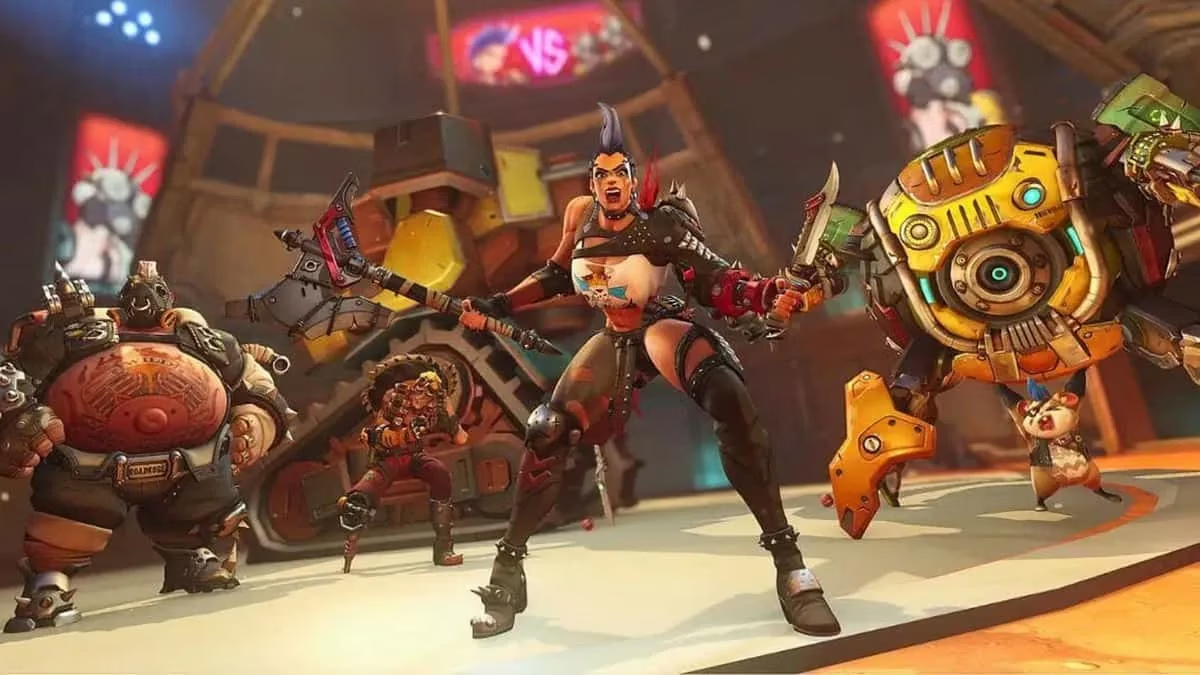
The first big shift arrived with Season 17, when Aatlis finally joined the rotation. For years, Flashpoint had only Suravasa and New Junk City, which meant every match started with the same two vibes. Aatlis gave the mode a third flavor, and while the developers were building it, they evolved their formula. Then they took those learnings back to the original two maps. The goal was simple: make Flashpoint more fun. That meant improving readability, enhancing each map’s theme, and ironing out the flow of objective spaces. Honestly, readability was the biggest issue for me. I could not tell where I was supposed to go half the time, and the minimap felt like abstract art.
Suravasa got the most drastic treatment. Certain features were replaced entirely, while other areas were adjusted in significant ways, whether it was scale or rotation. I remember loading into the new Suravasa and doing a double take. The old sightlines that used to punish me for existing were gone or reshaped. The map felt less like a sprawling death maze and more like a series of intentional arenas. It was as if Suravasa itself had finally taken a deep breath. New Junk City, meanwhile, was reworked across all control points. The result is a map that’s opened up and feels more fluid and fun to navigate without losing its chaotic charm. And yes, the chaotic charm is still there. I still got booped off a ledge by a Lucio, but this time I laughed instead of logging off.
But the biggest change isn’t even on the maps themselves. It’s how Flashpoint works as a whole. Up until the rework, the logic of how each subsequent capture point was determined felt unfair. After the first point in the middle of the map was captured, the next control point would show up closer to the losing team’s spawn room. That inherently removed the possibility of diagonal movement across the map. Blizzard considered this a big source of frustration, and I agree. It made the mode feel like a tug-of-war where one side got to skip rope. Now that logic is gone. The experience of playing Flashpoint should be far smoother, and in practice, it is. Rotations feel less scripted. Fights break out in more interesting places. The mode finally breathes.
Let me put it this way: Flashpoint used to feel like a game mode designed by someone who loved chaos but hated navigation. Now it feels like a game mode designed by someone who loved chaos and finally learned how to draw a straight line. That’s not a knock on the old version. It’s just the truth. The rework is the most substantial overhaul in Overwatch 2 history for a reason.
Here’s a quick breakdown of what changed:
| Feature | Before | After |
|---|---|---|
| Maps | Suravasa, New Junk City | + Aatlis, plus reworks to original two |
| Suravasa | Wide open, confusing flow | Drastic structural changes, replaced features, adjusted scale/rotation |
| New Junk City | Chaotic but cluttered | All control points reworked, opened up, more fluid |
| Capture logic | Next point closer to losing team’s spawn | No longer forced; diagonal movement possible |
| Overall feel | Frustrating, slow duels | Smoother, more readable, more fun |
I won’t pretend the mode is now my favorite thing in Overwatch 2. Stadium still exists, and I still have a soft spot for good old-fashioned payload. But Flashpoint no longer feels like a chore. It feels like a mode with an identity. The maps have themes you can actually notice. The objective spaces flow. The fights are still messy, but they’re messy in a way that makes sense. And that’s all I ever wanted.
If you bounced off Flashpoint back in 2023, I get it. I did too. But in 2026, the mode is worth another look. Blizzard didn’t just slap a fresh coat of paint on it. They rebuilt the bones. And sometimes, that’s exactly what a game mode needs to stop floundering and start glowing. 🎮✨
Maybe I’ll see you on Aatlis. I’ll be the one trying to figure out which direction is diagonal.
Comments