
My Unplanned Journey: Getting Stuck in an Enemy Spawn During an Overwatch 2 Flashpoint Match
A bizarre Overwatch 2 Flashpoint match reveals the game's strict integrity rules, as Reinhardt's Charge into an enemy spawn triggers an instant, disorienting teleport.
As a dedicated Overwatch 2 player, I recently had one of the most bizarre and eye-opening experiences in my years of gaming. It all happened during a high-stakes Flashpoint match, a mode I've grown to love for its frantic, best-of-five control point battles. I was playing as Reinhardt, my trusty Crusader, locked in a tense duel with an enemy D.Va on the outskirts of the map. In the heat of the moment, I saw an opportunity. I activated my Charge, aiming to pin that pesky mech and secure an elimination. What followed was a sequence of events that taught me a hard lesson about the game's invisible boundaries and fairness mechanics in a way no patch notes ever could.
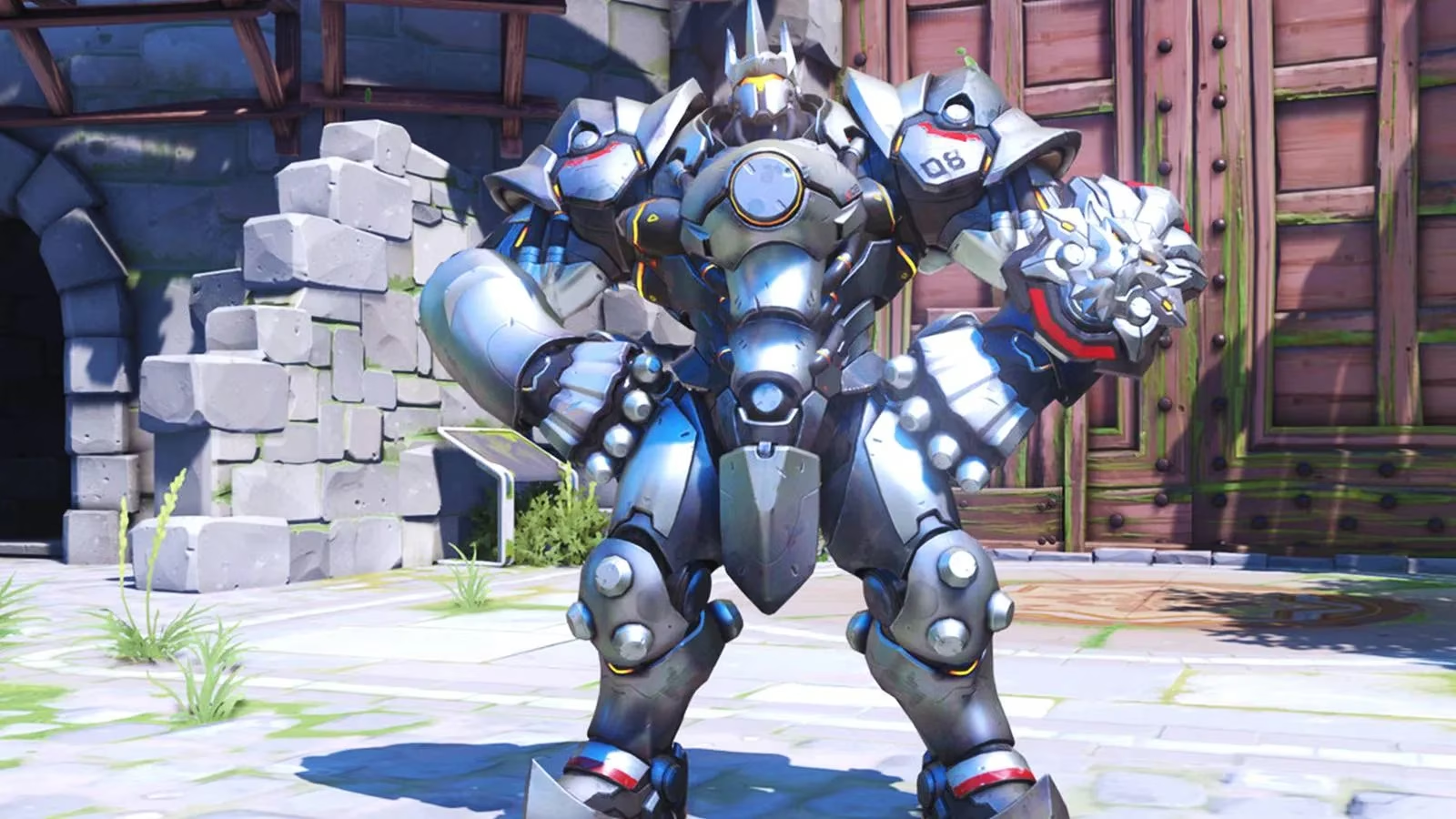
My Charge connected perfectly. I slammed into D.Va and, with immense momentum, carried her through a doorway and into what I quickly realized was an enclosed, indoor room. My initial thought was pure tactical excitement—'I've got her cornered!' I began swinging my Rocket Hammer with all my might, the satisfying clangs echoing in the small space. D.Va's mech was on the verge of breaking. And then, in the blink of an eye, the world dissolved around me. My screen flashed with a stark, white message: "Relocating from enemy spawn." Before I could even process the words, I found myself standing in a completely different, open area of the map, my hammer still mid-swing through empty air. The confusion was absolute. One second I was about to secure a key pick, the next I was disoriented and utterly exposed, immediately becoming easy prey for the regrouped enemy team. The match clip I saved is a whirlwind, but it perfectly captures that jarring, instantaneous teleportation.
This personal mishap led me to deeply research and understand the Flashpoint game mode's core integrity systems. Introduced as one of Overwatch 2's newest PvP modes, Flashpoint tasks two teams of five to battle over three sequential control points on large, sprawling maps. The first team to capture three points wins. It's a mode of constant rotation and strategic positioning. What I learned—the hard way—is that a fundamental, non-negotiable rule of this mode is the sanctity of the enemy spawn room. These are safe zones where the opposing team respawns and prepares, and the game's code is designed to prevent any foul play or camping in these areas. My accidental pin into that room triggered a failsafe. To prevent the game from breaking or creating an unfair stalemate, the system instantly teleported me, Reinhardt, to the nearest 'safe' and accessible location on the map. The fact that the teleportation occurred without any delay, even interrupting my attack animation, proves how serious and instantaneous this rule is. The game truly doesn't mess around.
Reflecting on it, my situation was a perfect storm of bad luck and positioning. I was in the wrong place at the exact wrong time. It's a rare event, but it highlights the invisible architecture that keeps Overwatch 2's matches running smoothly. I'm not the only one who's been curious about these boundaries, though. In discussions with other players online, one person shared their own systematic attempt to test this limit. They tried repeatedly to use Sombra's Translocator ability to sneak into an enemy spawn during a Flashpoint match. The result? Not a merciful relocation like I experienced, but an immediate death every single time. This suggests the game may have different methods of enforcement depending on the circumstance or ability used, but the intent is crystal clear: stay out of the enemy spawn.
This experience has given me a newfound appreciation for the different game modes in Overwatch 2 and how each is finely tuned:
-
Control: The classic king-of-the-hill style. Two teams fight to capture and hold a single objective point. It's a pure, concentrated team fight.
-
Escort: One team attacks, pushing a payload along a set path, while the other defends. It's a battle of momentum and staged defenses.
-
Capture the Flag: A chaotic classic of theft and defense, requiring a different kind of awareness and hero choice.
-
Flashpoint: The new, dynamic kid on the block. It's about map control, rapid rotations, and, as I learned, respecting spatial rules to keep the competition fair for everyone.
Playing in 2026, the game continues to evolve, but these core mode principles remain solid. My unexpected teleportation wasn't a glitch; it was the game working as intended to preserve competitive integrity. It serves as a reminder that even in the chaos of rocket hammers and mech explosions, there's a complex system ensuring every match, especially in modes like Flashpoint, starts on a level playing field. So, to all my fellow tanks and flankers out there: charge, dive, and brawl with all your heart, but maybe double-check your trajectory near those spawn room doors. You might just take an unintended fast travel trip across the map!
Comments