
Diablo 4 and Overwatch Crossover Leaves Both Fan Bases Cold
Diablo 4 and Overwatch crossover delivers vibrant armor sets, currency, and Kiriko's Fox Spirit pet in Season of Death Awakening.
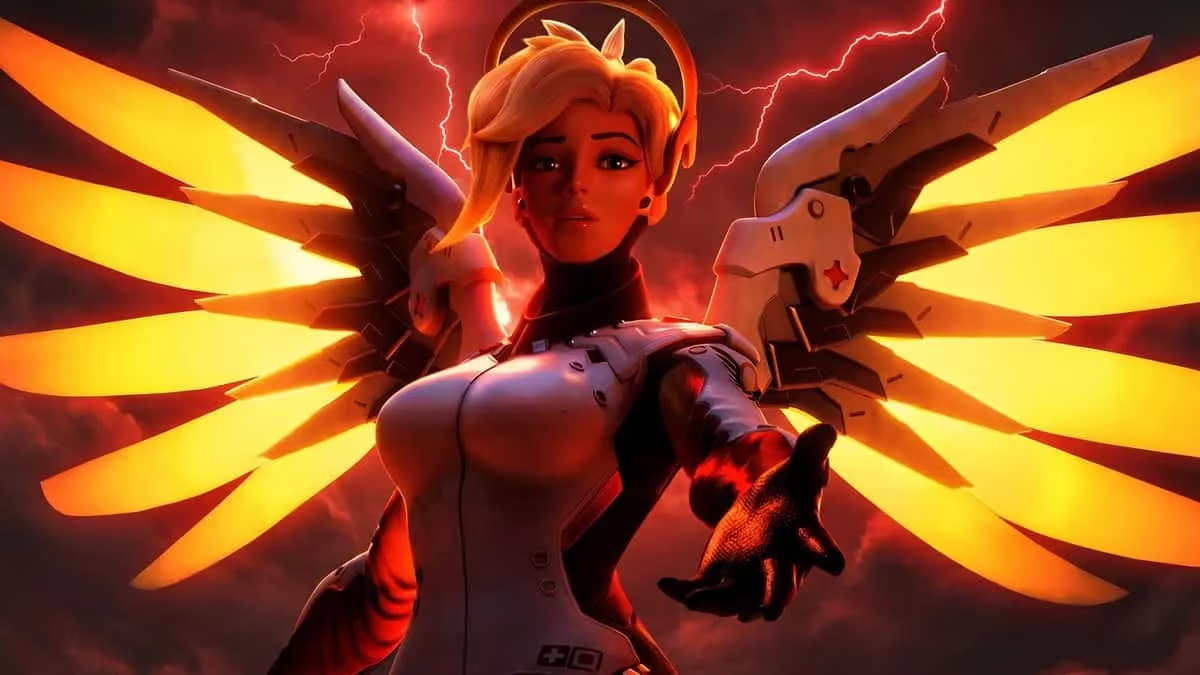
Blizzard has stitched two of its most tonally distant universes together, and the seam is already fraying. On June 30, Diablo 4 launches a crossover with Overwatch alongside Season 14, titled Season of Death Awakening. Armor sets inspired by Reinhardt, Mercy, Roadhog, Kiriko, Moira, Brigitte, Genji, and Reaper will appear in the in-game shop from 12:00 p.m. PT. A free Reliquary will also let players grind Elite and Champion monsters for Overwatch-themed currency, with Kiriko's Fox Spirit pet waiting at the end. The pitch is simple: take heroes from a bright, competitive shooter and drop them into a world where the color palette runs from blood-red to pitch-black. The execution, however, has landed like a neon arcade cabinet bolted onto a Gothic cathedral. Both audiences have noticed.
A Crossover That Feels Like Two Climates Colliding
Diablo is the darkest game Blizzard makes. Its atmosphere suggests that God has abandoned the player personally, and its hamster-mech pilot equivalent from Overwatch would not last five minutes in Sanctuary. Overwatch, by contrast, is a carnival of kinetic color, quips, and esports-ready silhouettes. Merging them is not impossible, but it requires a delicate touch. According to Blizzard's live services design director Dan Tanguay, the collaboration is a deliberately lighter direction as Diablo 4 enters its third year. He told GameSpot that the studio is not trying to make Diablo 4 lighthearted, adding that he does not think it will ever reach a point where the game suddenly becomes that. The statement attempts to reassure, yet it also confirms the obvious: the crossover is a tonal experiment, and experiments can explode.
What Players Are Getting
The crossover's content is concrete, even if its reception is not.
| Feature | Detail |
|---|---|
| Launch date | June 30, alongside Season 14: Season of Death Awakening |
| Shop timing | Armor sets available from 12:00 p.m. PT |
| Inspired by | Reinhardt, Mercy, Roadhog, Kiriko, Moira, Brigitte, Genji, Reaper |
| Free track | Reliquary with Elite and Champion monster grinding |
| Currency | Overwatch-themed currency |
| Final reward | Kiriko's Fox Spirit pet |
For players who enjoy collecting, the offer is straightforward. For players who treat Diablo's aesthetic as a sacred text, the offer reads like a foreign translation. The free Reliquary adds a grind loop, but it does not answer the larger question: why these two franchises, and why now? The answer may be less artistic than economic. Blizzard owns both properties, and live-service games thrive on events that pull players across ecosystems. Yet a crossover is not a neutral act. It is a statement about what a game's world can contain, and some fans hear that statement as an insult.
The Diablo Reaction: A Netflix Adaptation in Hell
Diablo players reviewing the trailer were not convinced. One called the skins 'a Netflix adaptation', a phrase that captures the polished but somehow wrong feeling of a beloved dark property being repackaged for a broader audience. Another asked why Overwatch had to be 'crammed into Diablo' and whether at least one Blizzard franchise could be left without what they called 'Disneyfication'. The complaints are not merely about armor models. They are about identity. Diablo's horror has always been a contract with the player: the world is hostile, the light is scarce, and hope is a currency spent in small, painful amounts. When that world starts selling cartoonish hero skins, the contract feels renegotiated without consent.
The Overwatch Reaction: Ozempic Hog and Other Casualties
Over on the Overwatch subreddit, fans were busy mourning what Diablo's darker, more realistic art style had done to their heroes. Roadhog's relatively slimmer proportions earned him the immediate nickname 'Ozempic hog', while Kiriko's face was described as 'killing' multiple commenters. The mockery is sharp, but it points to a real tension. Overwatch heroes are designed as readable, expressive icons. Diablo's art direction pulls them toward grit, shadow, and anatomical realism. The result can look like a taxidermy diorama where the wolf has been dressed in a hamster's sweater: technically assembled, but spiritually confused. Neither side seems particularly pleased, and the unhappiness is symmetrical.
The Reverse Experiment and the $40 Ghost
This is not the first time the two franchises have exchanged wardrobe. The Hatred's Reckoning Overwatch event in April ran the same trade in reverse, bringing Diablo's gloom into Overwatch's arena. The original Diablo x Overwatch collaboration in 2023 ended with Blizzard breaking its silence on a $40 Lilith Moira skin after players revolted over the price. That history matters because it shows that crossover fatigue is not new. It also shows that pricing can turn a cosmetic disagreement into a referendum on trust. In 2026, the stakes are higher. Live-service games are older, audiences are more vocal, and every collaboration is judged not only by its art but by its economy.
A Deliberately Lighter Direction With Heavy Consequences
Tanguay's framing suggests Blizzard wants Diablo 4's third year to feel less unrelentingly grim. That goal is understandable. A game cannot survive on despair alone, and seasonal content needs variety. But the company is walking a ridge line. Make the game too light, and it loses the identity that made it distinct. Keep it too dark, and the live-service machine struggles to sell playful cosmetics. The crossover is an attempt to balance those pressures, and the early response suggests the balance is precarious.
The collaboration is a weather system moving through two climates, dropping hail on one side and glitter on the other. It may still find an audience among players who care more about cosmetics than canon, or who simply enjoy seeing Blizzard's universes collide. Yet the loudest voices so far are not celebrating. They are asking whether every franchise must eventually become a mall, and whether some doors should stay closed. For Diablo 4 and Overwatch, June 30 will not just launch a season. It will test whether two fan bases can tolerate sharing a wardrobe, or whether the seams will tear wider.
Comments