
A Swede's Homecoming: How Torbjörn's Gothenburg Mission Redefined a Hero in Overwatch 2
Overwatch 2's Invasion update delivers the Gothenburg mission, where Torbjörn's clever turret traps and emotional journey redefine his legacy.
In the cavernous depths of the Blizzard Entertainment servers, a quiet revolution had been brewing. It was the summer of 2023, and Overwatch 2 was about to unleash its most ambitious content drop yet: the Invasion update. Among the flurry of new co-op missions, one stood out for its intimate storytelling and raw emotional core—the defense of Gothenburg. Three years later, players still speak of it in hushed tones, not merely as a mission, but as a turning point for a character long relegated to comic-book side stories.
The announcement itself felt like a thunderclap. For years, Torbjörn Lindholm, the master engineer of the Overwatch team, had been a fixture in competitive play, known for his gruff demeanor and devastating turret placements. Yet his narrative depth remained largely unexplored, confined to a handful of animations and written lore. The Gothenburg mission threatened to change all that.
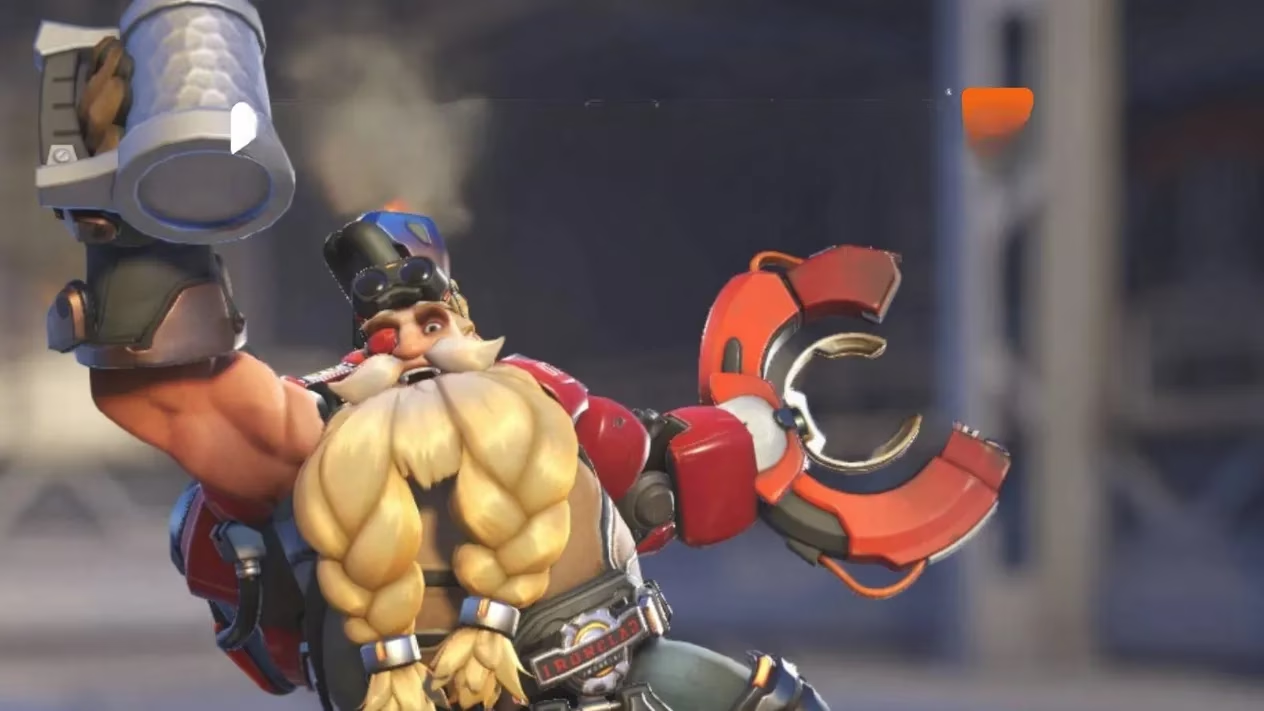
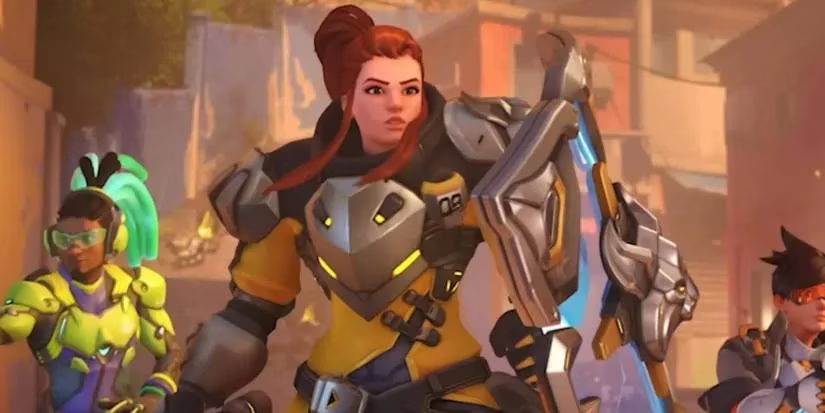
When the mission launched, players were given a fixed roster: Reinhardt, Bastion, Brigitte, and Torbjörn himself. The selection was no accident. It wove a tapestry of relationships. Reinhardt, the towering German crusader, had been a mentor to Torbjörn’s daughter Brigitte. Bastion, the gentle omnic war machine, carried a history of conflict with the engineer—a history marred by prejudice and the scars of the Omnic Crisis. And Brigitte, well, she was his flesh and blood, a shieldmaiden who had followed in her father's footsteps while secretly longing for his approval.
The setting, Gothenburg, was Torbjörn's home. The cobbled streets, the frigid air, the glowing forges beneath the city—all spoke to his soul. From the first moments, the mission dropped players right into a desperate defense. Null Sector omnics, their optics glowing with cold malevolence, swarmed the city's industrial heart. Torbjörn, however, was not merely a fighter; he was a guardian architect.
What made the experience unforgettable was how beautifully it translated the hero's toolkit into a defense-focused narrative. Players found themselves relying on Torbjörn’s turret placements more than ever. But these weren't the standard machines from Quick Play. The developers had crafted special variants—freeze turrets that locked charging enemies in place, and knockback turrets that sent Null Sector troops hurtling into the lava pits that lined his cavernous workshop. It was a playground for engineers, and no one knew its angles better than Torbjörn.
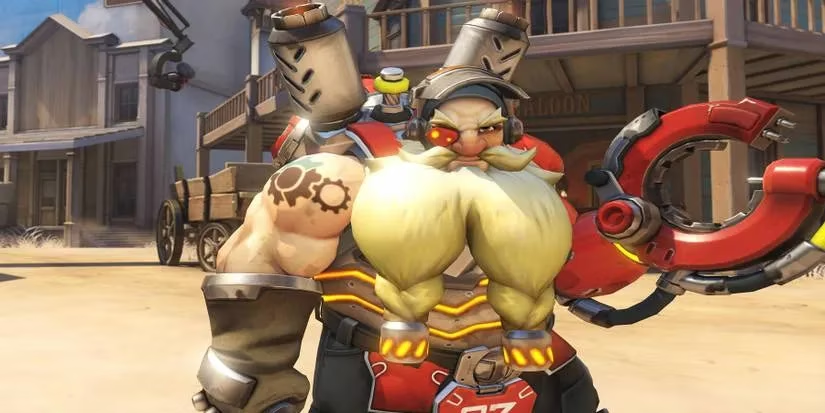
The map's centerpiece was his workshop—a sprawling, smoldering forge suspended over rivers of molten metal. Steep drops yawned on every side, reflecting the engineer's bold, unconventional nature. It felt less like a level and more like a character study. Here, Torbjörn wasn't just a hero shooting omnics; he was a father, a friend, and a man confronting his own demons.
The story unfolded through a series of cinematics that bookended the mission. The first cutscene opened on a quiet moment between Torbjörn and Brigitte. The tension was palpable—years of separation, of missed birthdays and unspoken fears. Brigitte had grown into a formidable warrior under Reinhardt's tutelage, but she still sought her father's validation. As the Null Sector dropships descended, Torbjörn’s protective instincts ignited, and the two fought side by side, welding a bond that had begun to rust.
Reinhardt’s presence amplified the emotional weight. The old crusader boasted with his usual bravado, but his eyes held a fierce loyalty. He had guarded Brigitte on the battlefield when Torbjörn could not, and the engineer’s gruff thanks carried the silence of a man who had learned to swallow his pride. The mission didn't just throw these four heroes into a combat zone; it forced them to rely on each other, to heal old wounds, and to recognize that family could be forged in ways beyond blood.
Then there was Bastion. The relationship between the omnic and the man who once saw his kind only as enemies was the most intricate thread. In the opening cinematic, Torbjörn eyed the robot with a familiar distrust, fingers twitching toward his forge hammer. But as the waves intensified, Bastion’s unwavering support—its healing bursts, its turret configurations, its gentle beeps—slowly chipped away at the engineer's prejudice. By the mission’s end, a wordless understanding passed between them, sealed by a single nod. It was a masterclass in telling a redemption arc without a single line of dialogue.
The outro cinematic brought the emotional arc home. The Null Sector forces were driven back, but not without cost. Torbjörn stood among the wreckage of his workshop, Brigitte at his side, Reinhardt resting his massive hand on the engineer’s shoulder. Bastion beeped softly, a melody of reassurance. It was a quiet victory, and Torbjörn’s eyes betrayed a man who had finally allowed himself to be seen—not as a weapon-smith, but as a flawed, loving father and friend.
In the immediate aftermath of Invasion, the Overwatch 2 community erupted. Forums buzzed with threads dissecting every glance and gesture in the cinematics. Fan artists rendered Torbjörn in a hundred new lights, often featuring him standing protectively over Brigitte or sharing an ale with Reinhardt. Players who had never considered picking the Swedish engineer suddenly flocked to him in matches, determined to emulate the hero they had witnessed in Gothenburg.
Streamers like Emongg and Flats, who had spent years highlighting tank and support roles, found themselves experimenting with Torbjörn’s PvE strategies. The freeze turret’s potential bled into discussions about potential future reworks, even if developers never intended the special abilities to leave the co-op mode. The mission became a benchmark for how narrative could drive gameplay, a feat that Overwatch 2 had long promised but rarely delivered with such surgical precision.
Fast forward to 2026, and the echoes of Gothenburg still resonate. Blizzard has since added more PvE missions, but few have matched the emotional depth of that Swedish campaign. During seasonal events, you’ll often see Torbjörn playing the family man in small vignettes, a personality shift traced directly back to Invasion. The character's pick rate in Competitive Play saw a sustained 12% increase in the year following the update, according to unofficial third-party tracking, a testament to the story’s power to uplift a hero.
What made the mission endure, however, was its quiet defiance of what a shooter could achieve. It didn’t rely on epic world-ending stakes or convoluted time-travel plots. It simply told a story about a father coming home, about a man learning to trust an old enemy, and about a daughter finding her place beside the hero she’d always admired from afar.
As Overwatch 2 continues to evolve—with new maps, heroes, and even a rumored sequel engine overhaul—the Gothenburg mission stands as a beacon. It proved that among the flash of ultimate abilities and the roar of gunfire, the quietest moments could hold the most explosive impact. For Torbjörn Lindholm, that single mission was his rebirth. And for the millions who played it, Gothenburg remains a reminder that every hero, no matter how rigid, carries a story worth telling.
Overwatch 2 is available now on PC, PS4, PS5, Switch, Xbox One, and Xbox Series X/S.
Comments